
Racine County Death Index
Racine County Death Index searches work best when you start with the date and the place. Racine County was organized from Milwaukee on Dec. 7, 1836, and the surviving local death trail begins in 1880, so the Register of Deeds in Racine is the right first stop for older county deaths. If you know a surname, a rough year, or a local town clue, the county search can move quickly. That is especially useful here because the county seat, the city of Racine, sits in a busy lake shore record system and the state office takes over after Oct. 1, 1907.
Racine County Death Index Overview
Racine County Death Index Office
The Racine County Register of Deeds is the main county office for Death Index work. It handles birth, marriage, death, and divorce certificates, and it also offers genealogy searches by appointment. That makes it the first place to check when you need an older local record or want to confirm whether a death belongs in the county file before you shift to the state system.
The register's birth, marriage, death, and divorce certificates page gives the practical request rules. It explains that some recent records can be obtained through county offices under the statewide issuance system, while older records still belong to the county where the event happened. For a Racine County Death Index search, that distinction keeps the request pointed at the right desk from the start.
The Racine Public Library gives the page its first local image and shows how a library can support a county death search when the office file needs one more clue.
That library view is useful because it reminds you that local research can sit beside the county record path instead of replacing it.
The Racine County Clerk page is the companion office to keep in view when a county contact question is broader than a single certificate request. It is useful for public record questions, office directories, and the local government path that sits next to the Register of Deeds. In a large county, that extra office context can save you from calling the wrong desk first.
Racine County Death Index Before 1907
Racine County death records begin in 1880, so the county file is the right place for the oldest local deaths that still survive in a usable form. The Wisconsin Historical Society's Racine County history page explains that the county was organized from Milwaukee on Dec. 7, 1836, with the seat of justice in the city of Racine. That long county history makes the surviving death record trail feel shorter, but it also gives the county search a clear local home.
For pre-1907 Racine County Death Index work, the county office and the historical society should move together. The county register gives you the local request path, while the historical society helps confirm the older trail. If the year is close to the 1880 start date, a small spelling change or a township clue may be the thing that decides whether the record shows up right away or needs a second pass.
The Wisconsin Historical Society image below comes from the county's historical essay and gives a visual marker for the older record trail.

That image is a useful checkpoint for a county that reaches back to the 1830s but whose death records do not begin until 1880.
The Wisconsin Historical Society records portal is also worth keeping nearby when the first search misses. It gives you a statewide way to compare a Racine County lead with the pre-1907 index and is especially helpful when the family story is stronger than the written record. In a county with a long civic history and a busy lake shore center, that comparison can save a lot of time.
Racine County Death Index Rules
After Oct. 1, 1907, Wisconsin DHS becomes the main state office for a Racine County Death Index request. The Wisconsin DHS Vital Records page explains the modern request route, and the certified copy page gives the practical order path when you need an official certificate instead of a research lead. That is the point where the county file stops being the main source and the state record system takes over.
The DHS genealogy page is the better choice when you need in-person research rather than a mail order. It explains the appointment system, the identification rules, and the controlled research process at the state office. For Racine County, that matters when the date is right but the exact name, spouse, or middle initial still needs one more look.
The state image below comes from the DHS genealogy page and shows the research desk that takes over once the county era ends.
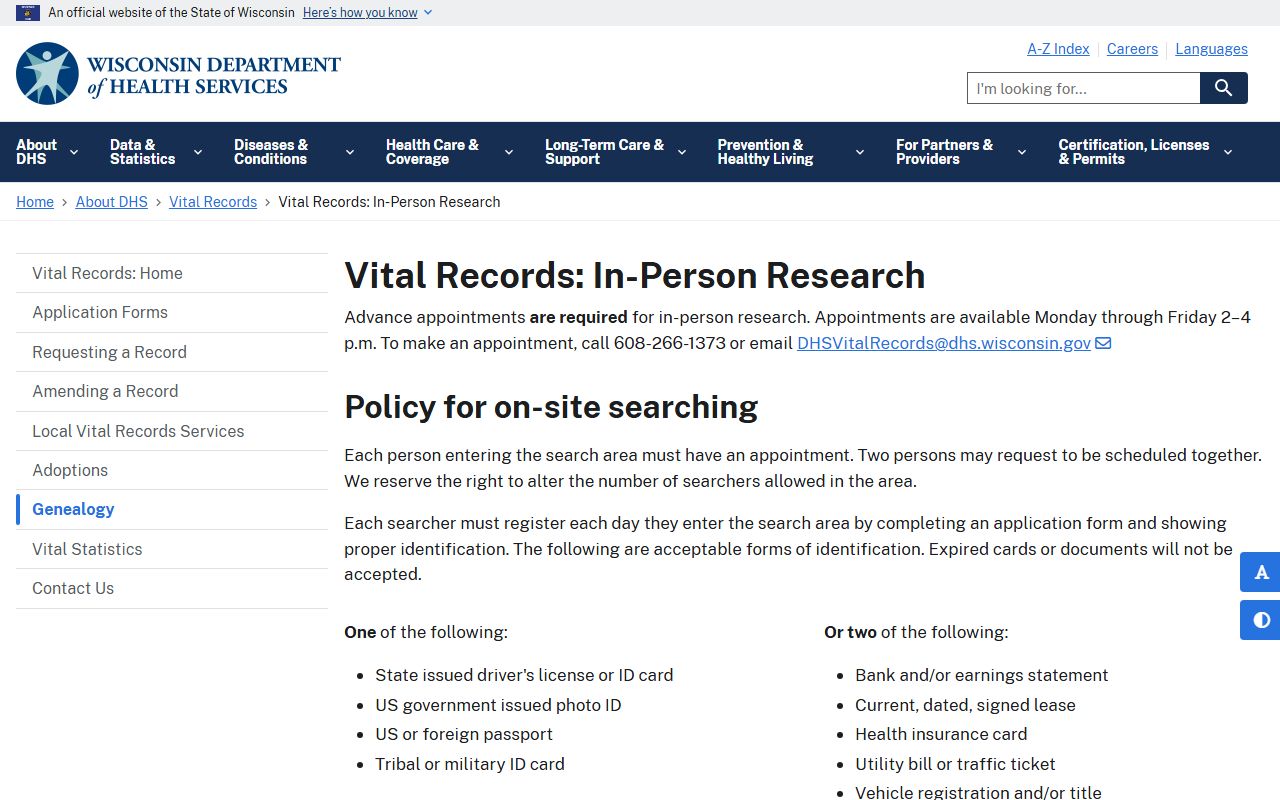
That fallback is a good fit for Racine County because it points to the state office used for later records and research visits.
Wisconsin Statutes Chapter 69 still controls access, certified copies, and the legal side of the request. The law page at docs.legis.wisconsin.gov/statutes/statutes/69 is the right place to check when a request question comes up. For a broader plain-language view, the Library of Congress Wisconsin guide, the Wisconsin Register of Deeds Association, and the Wisconsin State Law Library vital records page all help explain how the county and state sides fit together.
Note: Racine County has a long history, but the death record search still turns on the 1880 start date and the 1907 state cutoff.
Racine County Death Index Research Help
The Racine Public Library is a strong local research partner for a Racine County Death Index search. Library tools can help you confirm a name, a burial clue, or a family line before you place a request. That is useful in a county where a death record may be easy to confuse with another person who lived in the same city or village and shared the same surname.
The Racine County Clerk page is the other local office to keep handy when you need a directory, a county contact path, or another official place to start a search. It does not replace the Register of Deeds, but it helps you understand the county office structure and where related public record questions should go. That can be useful when the search needs a second stop instead of a single copy request.
The Racine County Register of Deeds certificates page and the Wisconsin Historical Society records portal work well together when you need to move from local office practice to the historical index. The county page explains how the office handles requests, while the historical portal helps you see whether the name belongs to the older county trail or needs a wider search. That is a practical way to avoid ordering too soon.
In Racine County, the best research habit is to treat the library, the county clerk, and the register as parts of one search system. Each one has a different job, and each one can save time if you reach it in the right order.
Racine County Death Index History
Racine County was organized from Milwaukee on Dec. 7, 1836, and the seat of justice was placed in the city of Racine. That long county history matters because it tells you the local government is old even though the surviving death trail starts later. When you search the Racine County Death Index, you are looking at a county that grew fast along Lake Michigan and built a strong civic center early.
The county's history also explains why the record search can feel busy. Racine is a well-known city, the county is tied to a major lake shore corridor, and many families moved through the area as the county grew. A name may appear in one record with a city clue and in another with only a township or a neighborhood reference. That makes the county history useful, not just interesting.
The Wisconsin Historical Society page gives the county's origin in a way that matches the record trail you see in practice. The County Death Index begins in 1880, but the county itself goes back much farther. Keeping both dates in view helps you decide whether you are searching the county era, the historical society index, or the later state certificate system.
Racine County Death Index Search Tips
The best Racine County Death Index search starts with a full name, a rough year, and a clear decision about whether the death belongs before or after Oct. 1, 1907. If you have a city, township, or burial clue, keep it ready. In a county this large, small details often do more work than a long list of possible spellings.
Before you contact the office, gather:
- Full legal name and any spelling variants
- Approximate date or year of death
- Whether the death was before or after Oct. 1, 1907
- City, township, or burial clue tied to the person
- Whether you need a research lead or a certified copy
If the year is still fuzzy, use the library and the historical society before you order. A newspaper line, a cemetery note, or a family card can narrow the search enough to keep you from paying for the wrong copy path. The county office will work better when the request already has a tight date range and a place clue that fits the local record trail.
Note: Racine County searches get easier when you sort the record by year before you sort it by office.